

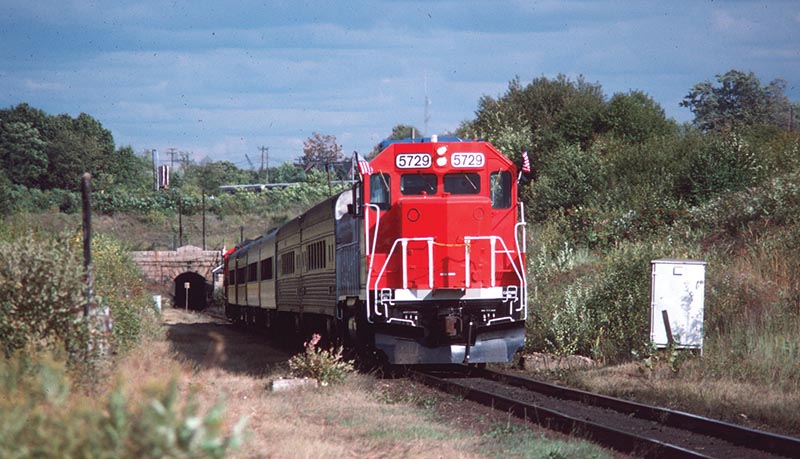
 Stephen C. Host and Kenneth Borg/photos as noted
The rail tunnels in Michigan and Ontario that enable Canadian Pacific Kansas City and Canadian National Railway to move traffic between our two countries are lifelines to the economy. Over a million rail cars a year traverse the Detroit-Windsor and Port Huron-Sarnia rail tunnels combined, amounting to billions of dollars of trade each year. Let’s dig into the history of the tunnels and how two countries cooperated not only to complete both tunnels, and how an American and Canadian author collaborated on this story as well!
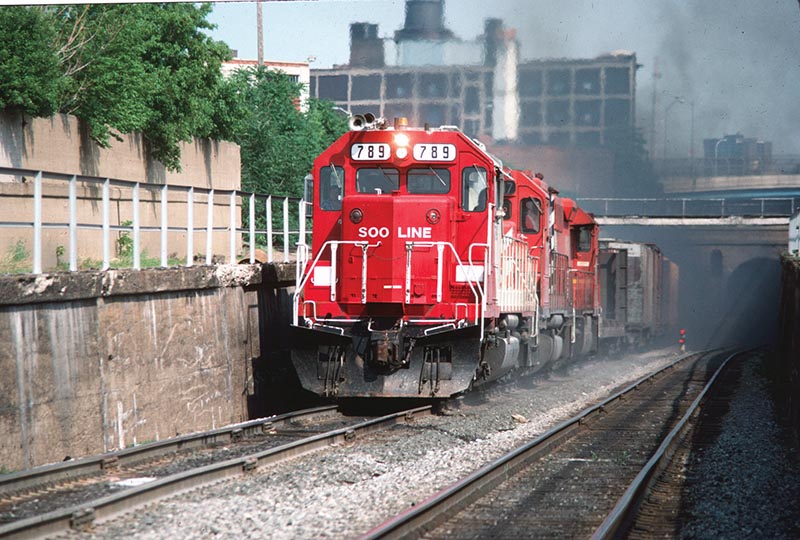
ABOVE: SOO/CP Train 501 with SOO 789 on the point blasts out of the Detroit River Tunnel in Detroit, Michigan May 30, 1988. The train would cross Michigan on the C&O to Porter, Indiana, then follow Conrail (now Norfolk Southern) rails into Chicago. C&O started using the tunnel in 1954. Prior to that, Pere Marquette used the carferry PM 10 to float cars from Detroit to the CPR slip in Windsor for traffic going east on C&O trains, and for interchange with the CPR. — Kenneth Borg
Windsor/Detroit
It would be the Americans that would finance and build the rail tunnel between Detroit, Michigan USA and Windsor, Ontario, Canada.
The Windsor-Detroit tunnel was built by the Michigan Central Railway in 1909, which later became the New York Central, Penn Central, and Conrail. It was enlarged in 1993 to accommodate most modern rail cars. It was the first immersed-tube tunnel put into service. For decades the tunnel was exclusively used by New York Central and Canadian Pacific passenger trains, while the Canadian roads Canadian National and Canadian Pacific (for freight), while U.S. roads Pere Marquette (C&O) and Wabash (Norfolk & Western, Norfolk Southern) had to use car ferries to move freight cars (CN passenger cars were also ferried) across the Detroit River. Eventually the CN stopped ferrying passenger cars to Detroit and used a bus. Canadian Pacific passenger service was reduced to a Budd RDC car.
All this began to change when the C&O got trackage rights through the tunnel in 1954. CP passenger service eventually ended, and Conrail received the tunnel when it got the Penn Central in 1976.
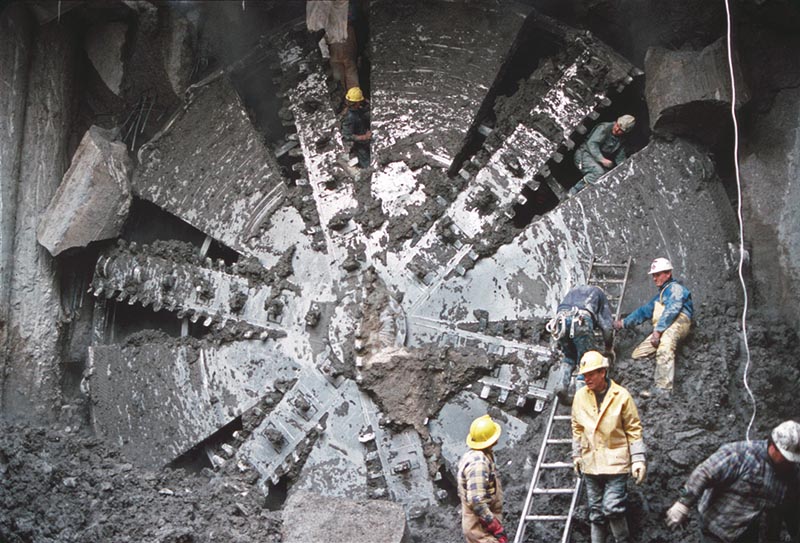
ABOVE: Holed Through: Workmen crawl through after the massive tunnel boring machine (TBM) has broken through to Port Huron, Michigan, on December 8, 1994. — Kenneth Borg
In 1985 CN and CP jointly purchased the Windsor tunnel, along with the Canada Southern across Southern Ontario, and CP freight trains began using the tunnel. CN, via Grand Trunk Western, ran a transfer from East Yard in Detroit to CN VandeWater Yard in Windsor, Ontario. After dropping and picking up their cars, the CN train would go back through tunnel and up to Pontiac, Michigan, where the cars were dropped and other cars picked up and the train returned to East Yard in Detroit. This six-day-a-week operation lasted only about two years. The majority of CN traffic used the St. Clair Tunnel and the rail car ferries at Sarnia/Port Huron.
Amtrak, in cooperation with the states of New York and Michigan, operated a passenger train from Buffalo to Detroit daily. This was an exten-sion of an Empire State Express out of New York City to Buffalo , which was extended to Detroit. This train become the Niagara Rainbow and it operated from October 31, 1974 to January 1979, when New York and Michigan withdrew funding.
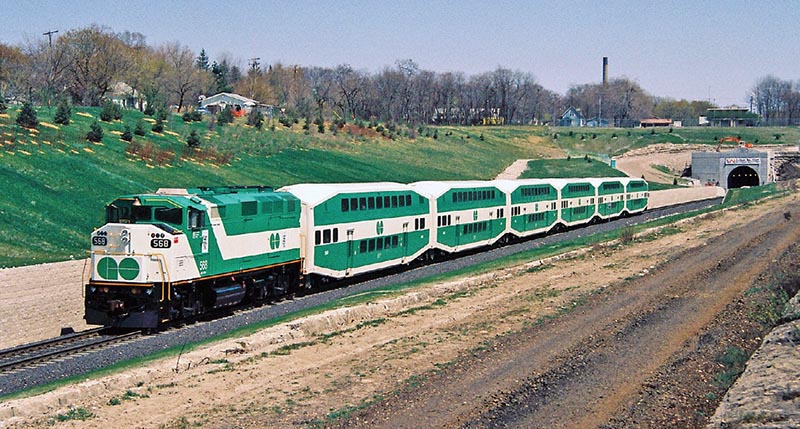
ABOVE: CN Family Fun Day was held May 6, 1995, the Saturday of the official Sarnia tunnel inauguration opening weekend. One of the shuttle trains utilizing borrowed GO Transit equipment is viewed having just exited the new tunnel in Port Huron, Michigan. That afternoon CN employees and their families from Canada and the US boarded trains that offered rides through the new tunnel. The following day, Sunday May 6, CN offered the general public the same opportunity with an estimated 15,000 people riding the shuttle trains between the two countries. — Jason Noe
CSX used the Windsor tunnel until 2013; at that point only a thrice-weekly CSX Rougemere–CP Windsor transfer job manned by CSX crews from Sarnia was operated. Today, CP runs a transfer, usually at night, from Windsor to CSX Rougemere Yard in Dearborn.
NS trains stopped using the Windsor tunnel in the mid-2000s when their agreement to operate trains through southern Ontario was cancelled. CPKC is the exclusive user of the Windsor tunnel in 2026 with the exception of rare CN detours when there is a derailment in the Sarnia tunnel to the north…