

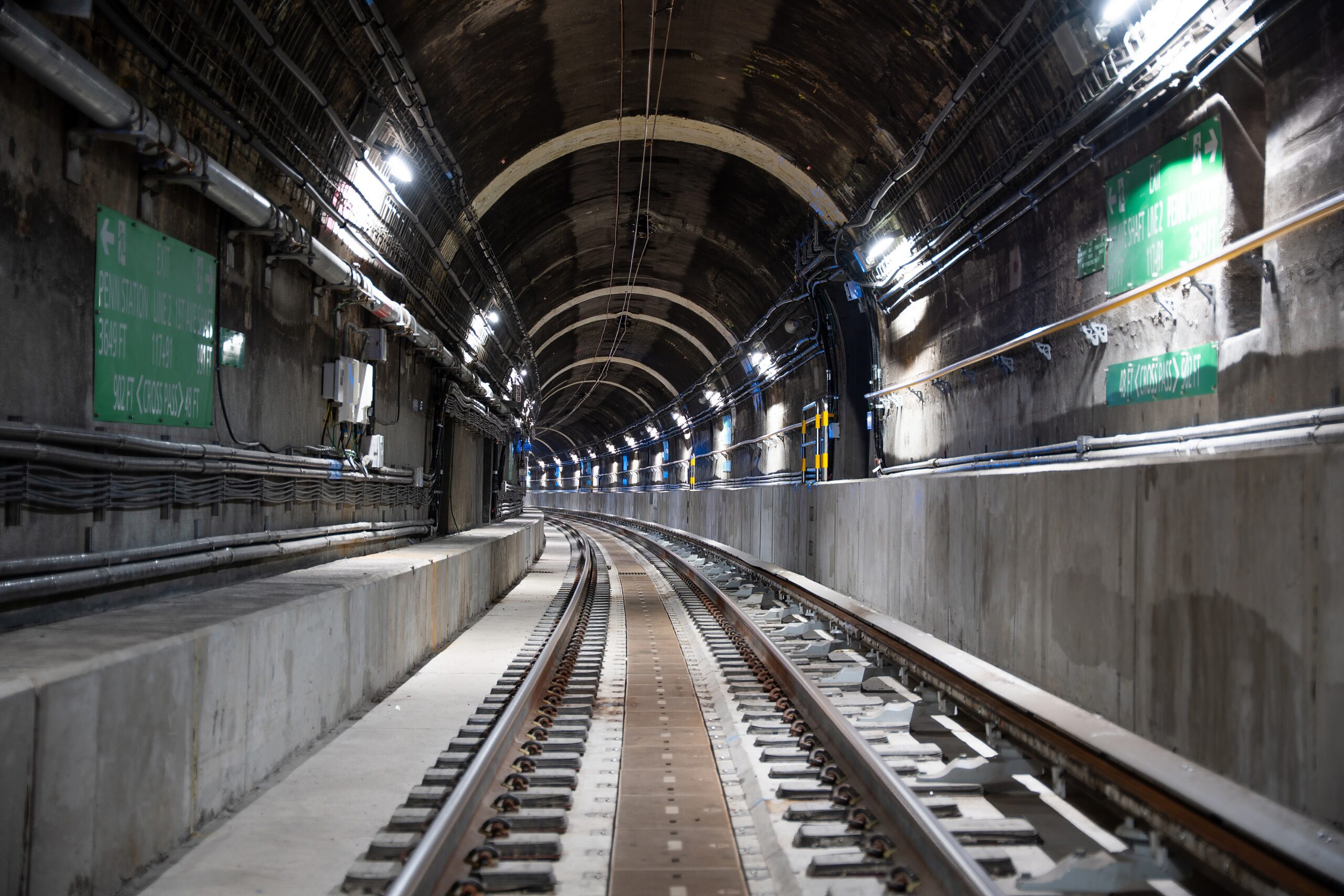
Amtrak officially reopened East River Tunnel (ERT) Line 2 this week, completing the first major phase of the ERT Rehabilitation Project and providing key safety and reliability improvements for thousands of daily Amtrak, Long Island Rail Road (LIRR), and NJ TRANSIT customers.
Over the past year, crews completely reconstructed the 116-year-old tunnel’s interior systems, including track, power, communications, drainage, and structural elements.
- This work involved demolition, removal, and replacement of significantly deteriorated infrastructure and incorporated construction of new bench walls designed to improve safety, maintenance access, and operational performance.
- In total, more than 24,000 feet of rail, 8,000 tons of ballast, 8,000 wooden rail ties, and 20,000 cubic yards of bench wall concrete were removed and replaced.
The East River Tunnel opened in 1910 and is one of the busiest passenger rail tunnels in the Western Hemisphere, serving 450 daily Amtrak, LIRR, and NJ TRANSIT trains. Two of the four tubes required significant repairs and comprehensive reconstruction following damage caused by floodwaters that entered the tunnel during Superstorm Sandy.
- The second and final phase of the project will begin this fall and feature the same scope of work for the Line 1 tunnel. Ahead of the work in Line 1, Amtrak will conduct additional hardening activities to reduce the risk of infrastructure failures, as was done for Line 2.
- The $1.6 billion project remains within budget and on track to finish by the end of 2027.
It is funded primarily by a federal grant administered by the Federal Railroad Administration, along with contributions from Amtrak, MTA, and NJ TRANSIT.
Throughout project construction, three of the four East River Tunnels remained available to ensure continued Amtrak, LIRR, and NJ TRANSIT service. Amtrak is committed to minimizing passenger impacts, and the company’s infrastructure hardening investments combined with mitigation actions helped to limit service delays during the Line 2 outage. Those efforts included around-the-clock engineering coverage, more frequent inspections as track access time permits, and strategically positioned rescue equipment.
-via Press Release
