

 Stephen A. Williams/photos by the author
Now that the Federal Government has finally deemed the Gateway Tunnel an essential project and has released the current funding allotment, work has been progressing at a feverish pace on both sides of the Hudson River. The sheer size and scope of this $16 billion project is massive and historical from every perspective. This is not the normal cut-and-cover tunnel project. The differing geologic conditions inherent at each of the Hudson River construction sites demand the use of new tunneling methodologies to overcome the challenging natural conditions at each location.
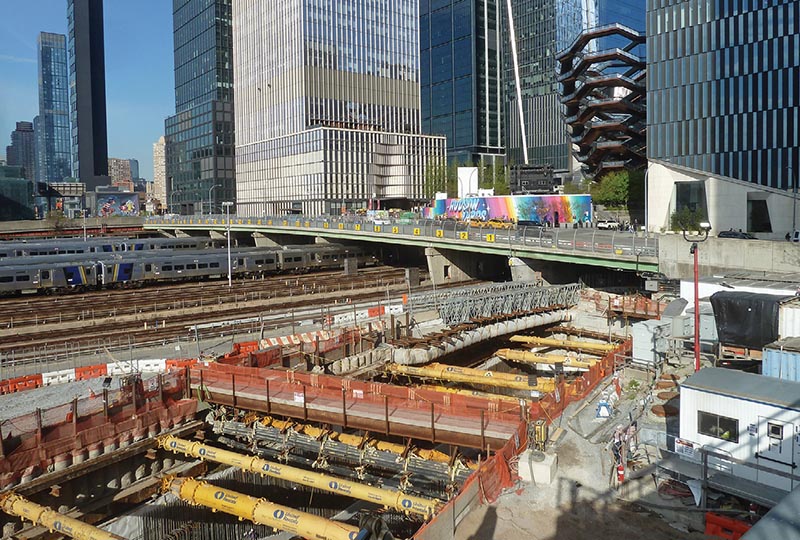
The Gateway Project encompasses several major northeast rail construction phases, chief of which is the Hudson Tunnel Project (HTP). The Hudson Tunnel Project includes excavation work at Manhattan’s Hudson Yards to create the protective concrete casing, stabilization of the Hudson riverbed, construction of the Twelfth Avenue and Weehawken air shafts and preparation of New Jersey’s Bergen Hill “launch box” to accept the new tunnel boring machines. Work at each of these locations is progressing steadily to ensure success of the projected tunnel completion date of 2035. The entire Hudson Tunnel Project is managed by a consortium of joint venture partners.
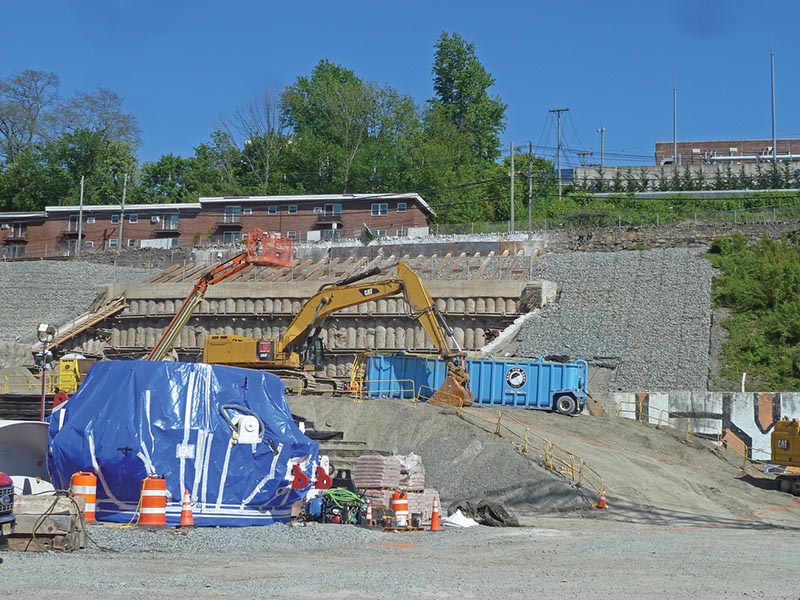
Overall view of the reinforced walls being prepared high above the North Bergen TBM “Launch Box” just east of Tonnelle Avenue. TBM sections are beneath the blue wraps. This view looks east toward Paterson Plank Road on May 4, 2026.
The preparation work is very intricate and labor intensive. The planners have taken extreme measures to prepare and stabilize each shoreline site to protect the new tubes from potential geological conditions that may threaten progress. And in the middle of the Hudson River, crews are busy installing rows of large cylindrical tubes deep into the riverbed to create a series of protective trench walls where the new tubes will be laid.
To put everything into perspective, these new tubes will be the fifth set of tunnels to be constructed on Manhattan’s west side during the last century. The Hudson & Manhattan (now PATH) subway-type tubes were first in 1909, followed shortly by the midtown Pennsylvania Railroad rail tunnels in 1910. The Holland Tunnel roadway tunnel opened November 13, 1927, and the first phase of the Lincoln Tunnel came in 1937, and now the Hudson Gateway rail tunnels. The PATH, PRR and Lincoln tunnels, and the Gateway tunnels, will be within blocks of each other. Consider the enormous volumes of earth and rock that must be excavated, the vast amount of utility, water and sewer lines that must be diverted, plus one hundred years of Hudson River debris and obstacles that must be removed, such as heavy ship chains and anchors…