

 Scott Ornstein/photos as noted
Old Saybrook, located in south-central coastal Connecticut, has great personal meaning to me, but it also has quite a history, some of which this writer only learned about as I put this story together. But it is the personal aspects of Old Saybrook that make it “My Favorite Spot.”
Old Saybrook History
According to Ronald Dale Karr’s The Rail Lines of Southern New England, which provided background information for this article, Old Saybrook was first served by rail in 1852, when the New Haven & New London Railroad completed construction and began service on what became known as the “Shore Line.” Through various ownership changes in ensuing years, the New Haven & New London was integrated into New York, New Haven & Hartford Railroad (the “New Haven”).
The New Haven eventually was merged into the Penn Central in 1969, which promptly went bankrupt in 1970, but limped along until 1976 when it became a primary component of Conrail. Meanwhile, Amtrak had been formed in 1971 to take over intercity passenger operations, although the motive power and equipment continued to carry “Penn Central” markings for some years afterward. Amtrak eventually purchased the infrastructure now known as the “Northeast Corridor” and took over direct operation of intercity passenger trains. It then began making major investments in the railroad infrastructure, including electrification to Boston, that are evident today. Freight service was also provided by these same carriers (except Amtrak) over the years, though Conrail suspended service to Old Saybrook in 1991. The Providence & Worcester Railroad began providing freight service in 1982.
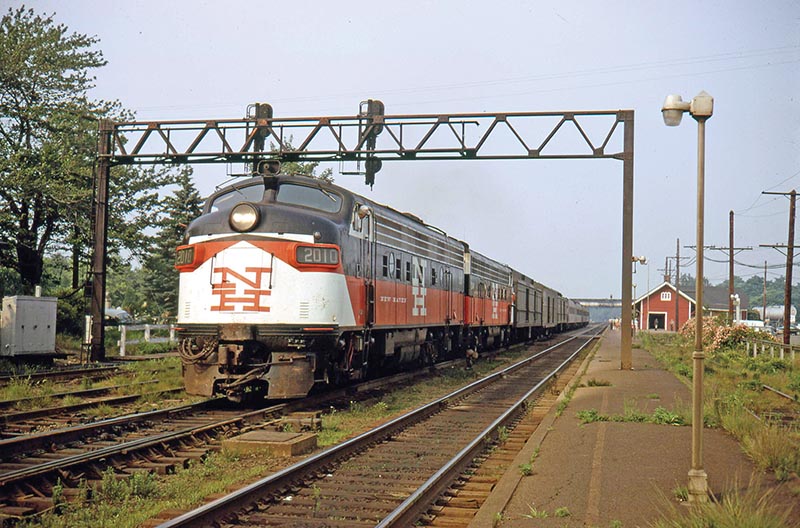
ABOVE: It was still “pure” New Haven Railroad in August 1968 when FL9 2010 led a train west into Old Saybrook. Head-end traffic was still robust, with three baggage cars leading four coaches. – T.J. Donahue
Old Saybrook was and is still sometimes referred to as “Saybrook Junction.” The east-west Shore Line was also served by the north-south Connecticut Valley Railroad, which began service on the 44-mile-long line between Hartford and Old Saybrook in 1871, and was eventually also consolidated into the New Haven in 1887. Service was extended three miles south of Old Saybrook (Junction) to the resort area of Fenwick in 1872. However, economic conditions and changing transportation patterns forced the New Haven to suspend service on the final mile of the route between Saybrook Point and Fenwick in 1917. Service on the two-mile segment between Old Saybrook Junction and Saybrook Point was simi-larly terminated in 1922.
The main portion of the Connecticut Valley Railroad north of the Shore Line was known as the Valley Division of the New Haven. It lost passenger service around 1930 but continued as freight-only trackage until 1968 when the New Haven Railroad abandoned the lower 23 miles of track between Saybrook Junction and Laurel, located south of Middletown.
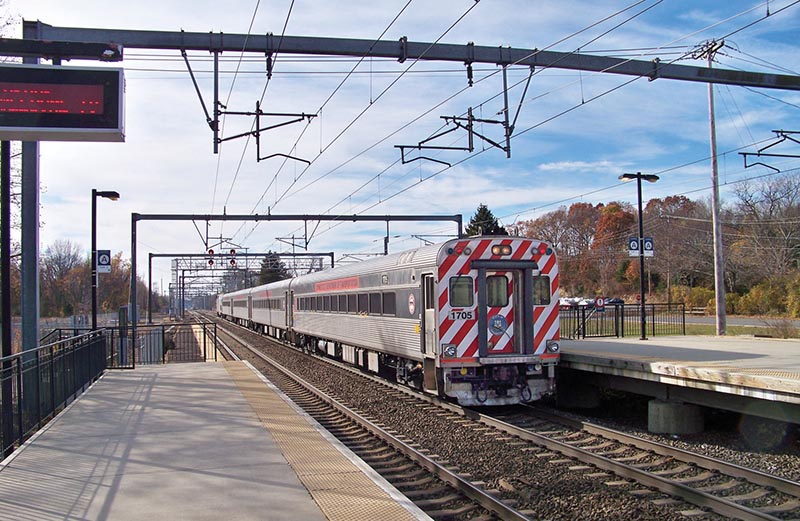
ABOVE: A CTrail Shore Line East train with former Virginia Railway Express Mafersa coaches pushed by a former Amtrak P40 on the west end, arrives at Old Saybrook on Track 1, November 14, 2010. – Scott Ornstein
Old Saybrook Today
Old Saybrook continues as an important station on Amtrak’s Northeast Corridor serving the lower Connecticut River Valley area between Boston and New York and points south to Washington. Located 33 miles east of New Haven and 17 miles west of New London, it is served by many, but not all, Amtrak Northeast Regional trains. Amtrak’s Acela trains generally blow by at speed without stopping. Since 1990, Old Saybrook has also been served by CTrail Shore Line East trains that provide local commuter service between New London and New Haven, with connections there to Metro-North trains to Grand Central Terminal. A few Shore Line East trains continue into Metro-North territory, but only as far as Stamford.
Much has changed at the Old Saybrook station itself, though much has stayed the same. The building was painted a bright red throughout much of its history, including during the 1970s era when I was a visitor, and once again it is painted as such, although it went through a period in the late 1970s–1980s when it was painted grayish blue. The station building, waiting room and ticket office have been updated, though it still retains a New England feel and quaintness.
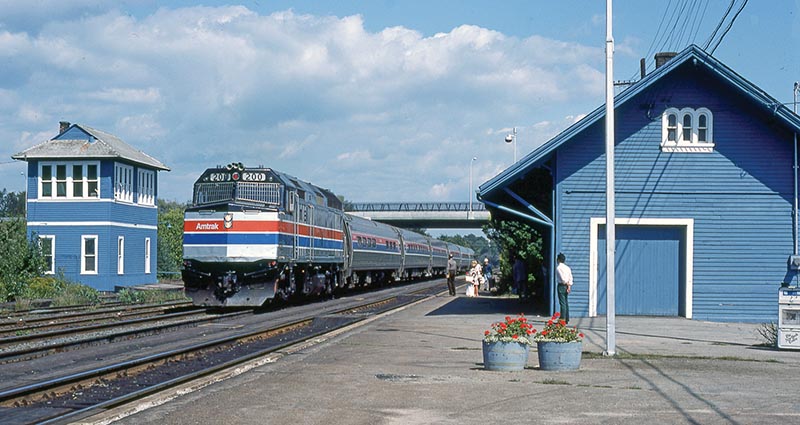
ABOVE: F40 200 leads Amtrak Train 173 as it completes its station work at Old Saybrook in September 1977. Saybrook Tower (S.S. 102) has received a new coat of paint. – T.J. Donahue
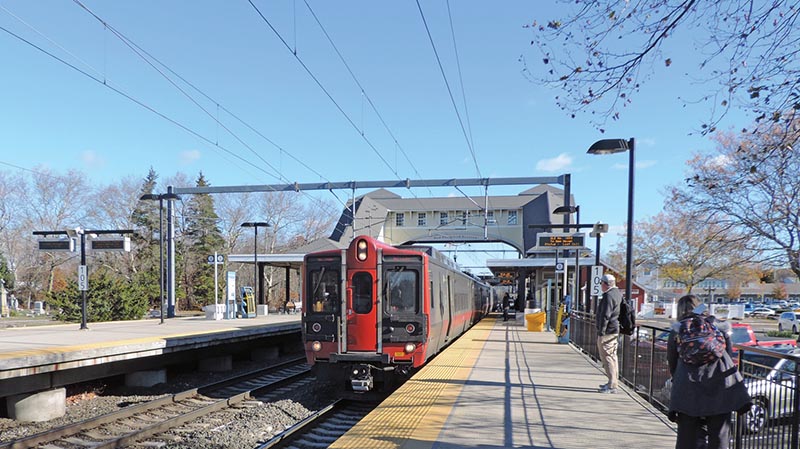
The adjacent former freight house is now a popular pizza restaurant. Catenary for the New Haven-Boston electrification was installed in the late 1990s. The old low-level platform with its wood plank walkways across the eastbound track to the narrow wood and asphalt westbound “platform” is gone, replaced as part of the catenary installation project by two short high-level platforms, a side-type for “eastbound” Track 2, and an island-type for “westbound” Tracks 1 and 3, and a rustic-looking overpass with elevators. The station is thus fully ADA accessible and accommodates high-speed train operations without having to worry about passengers walking over active tracks. In reality of course, eastbound and westbound designations are basically obsolete, and with a modern signal system in place, each track is bi-directional. On several recent visits to Old Saybrook, bi-directional service was observed on Tracks 1 and 2, with Track 3 used once, by a west-bound Shore Line East consist, seemingly to allow an Acela to overtake on Track 1. There is a small amount of freight service on this part of the Shore Line, operated by the Providence & Worcester Railroad, usually at night…
